When buying a portable air compressor, the five most important factors to evaluate are tank size, maximum PSI, CFM output, power source, and noise level — in that order of priority for most users. A compressor that cannot deliver enough CFM for your tools will fail the job no matter how large its tank or how high its pressure rating. The right portable air compressor matches your specific application: a tire inflator for roadside use demands something entirely different from a unit powering an impact wrench in a workshop. This guide covers every specification that matters, with concrete numbers to benchmark against, so you can make a confident, data-backed purchasing decision.
Why CFM Is the Most Critical Spec When Choosing a Portable Air Compressor
CFM (cubic feet per minute) is the single most important specification on any portable air compressor because it determines whether your tools will actually run. PSI tells you the pressure available; CFM tells you the volume of air the compressor can continuously supply. If your tool requires more CFM than the compressor can produce, it will stall, underperform, or cause the compressor to overheat trying to keep up.
Always check the CFM rating at the working pressure your tool requires — usually 90 PSI for pneumatic tools. Manufacturers sometimes publish CFM at 40 PSI or 90 PSI, and the 40 PSI number will be significantly higher. The rule of thumb for tool selection:
- Tire inflator and blow gun: 1–2 CFM at 90 PSI — any compressor can handle this.
- Nail gun (brad or finish nailer): 1–2.5 CFM at 90 PSI — intermittent demand; a small 1-gallon tank compressor works.
- Framing nailer: 2–4 CFM at 90 PSI — moderate demand; 4–6 gallon tank recommended.
- Impact wrench (1/2 inch): 4–5 CFM at 90 PSI — continuous tool; compressor CFM must match or exceed tool requirement.
- Random orbital sander: 6–9 CFM at 90 PSI — high-demand tool; requires a compressor rated at minimum 6 CFM at 90 PSI.
- Die grinder: 4–6 CFM at 90 PSI — sustained high demand; undersized compressor will cycle constantly and overheat.
- Spray gun (HVLP): 10–14 CFM at 29–45 PSI — the most demanding common application; requires a large compressor or dedicated spray unit.
When sizing a compressor, add a 25–30% buffer above the tool's CFM requirement. If your impact wrench needs 4.5 CFM, buy a compressor rated at 6 CFM or more at 90 PSI. This buffer prevents the compressor from running at 100% duty cycle continuously, which is the leading cause of premature motor failure.
What Tank Size Do You Need in a Portable Air Compressor?
Tank size determines how long your tools can run before the compressor motor kicks on to refill — a larger tank means fewer motor cycles and more consistent air pressure for sustained tasks. However, tank size is secondary to CFM: a 6-gallon tank on a low-CFM compressor will deplete and require refilling just as often as a 1-gallon tank if the tool demand consistently exceeds the pump's output.
Match tank size to your typical use pattern:
- 0.5–1 gallon: Ultra-portable inflators and brad nailers. Excellent for tire top-ups, sports equipment inflation, and finish carpentry where the tool fires infrequently. Fits in a backpack. Refills in 20–40 seconds.
- 2–4 gallon: The most popular range for contractors and DIYers. Suitable for finish nailers, trim nailers, and staple guns. Pancake compressors in this range weigh 20–30 lb and fit in a vehicle trunk easily.
- 4–6 gallon: Good balance of portability and capacity. Handles framing nailers, inflation tasks, and light impact work. The 6-gallon pancake is the most widely sold format in this category.
- 8–20 gallon: Wheeled "jobsite" portables. No longer fits in a hand-carry sense, but can be moved by one person with wheels. Suitable for sustained air tool use, painting, and light sandblasting. Many two-stage models fall here.
One practical benchmark: a 6-gallon tank at 150 PSI maximum contains approximately 0.9 cubic feet of compressed air usable above 90 PSI. An impact wrench consuming 4.5 CFM will drain this reserve in about 12 seconds of continuous use. That is why CFM — the pump's continuous output — matters far more than tank volume for sustained tool use.
What PSI Rating Should a Portable Air Compressor Have?
For most portable applications, a maximum PSI of 125–150 is sufficient — but higher is better as a buffer, not because your tools need it. The vast majority of pneumatic tools operate between 70–120 PSI. A compressor with a 150 PSI maximum tank pressure and a regulator set to 90 PSI gives you a comfortable working range and reasonable reserve volume before refilling.
Key PSI benchmarks to understand:
- Maximum tank PSI: The pressure to which the pump fills the tank (typically 125–175 PSI on portable units). Higher max PSI means more stored air energy in the same tank volume.
- Cut-in / cut-out pressure: The pressure at which the motor restarts (cut-in, typically 90–110 PSI) and stops (cut-out, the maximum PSI). A wider gap between these means fewer motor starts per hour.
- Regulated working PSI: The pressure delivered to your tool via the regulator. Set this to match the tool manufacturer's specification — usually 70–120 PSI. Running tools above their rated pressure accelerates wear and can be dangerous.
- Tire inflation PSI: Most passenger tires require 30–50 PSI. Any compressor with a 100+ PSI maximum can inflate tires, but a unit with a maximum of only 30 PSI (some low-cost inflators) cannot fill a tire that is completely flat.
Which Type of Portable Air Compressor Is Right for Your Application?
The four main types of portable air compressors are pancake, hot dog, twin-stack, and wheeled vertical — and each makes a different trade-off between portability, capacity, and performance. Choosing the wrong form factor is one of the most common mistakes buyers make.
Pancake Compressor
The flat, round tank design gives the pancake compressor an extremely low center of gravity, making it stable on uneven surfaces and easy to slide under workbenches. Tank sizes of 3–6 gallons dominate this format. Weight is typically 20–33 lb. This is the best all-around choice for contractors doing trim work, flooring, and roofing where the compressor must be carried up ladders or through tight spaces.
Hot Dog Compressor
A single horizontal cylindrical tank (2–5 gallon) with the motor mounted on top. Slightly more compact than a pancake in footprint but taller and less stable. Best suited for finish carpentry and light inflation tasks. The hot dog format has largely been displaced by the pancake in professional use because the pancake offers better stability and similar capacity in a lower-profile package.
Twin-Stack Compressor
Two horizontal tanks stacked one above the other (total 4–8 gallons) give the twin-stack more capacity than a pancake while maintaining a relatively compact footprint. The stacked geometry keeps the unit narrow, which is useful in tight crawl spaces or vehicle beds. CFM output is typically higher than single-tank pancake units of similar power — a twin-stack at 2.0 HP commonly delivers 5–6 CFM at 90 PSI compared to 3–4 CFM for a 1.5 HP pancake.
Wheeled Vertical (Jobsite) Compressor
A vertical tank (8–20 gallon) mounted on a wheeled base with a long handle for tipping and rolling. Too heavy to carry (40–80 lb or more) but highly capable — most wheeled portables deliver 5–8 CFM at 90 PSI and support sustained use of impact wrenches, spray guns, and multiple nailers simultaneously. The best choice for construction sites, garages, and anyone who needs serious air capacity without a stationary compressor.
| Type | Typical Tank | Typical CFM at 90 PSI | Weight | Best For | Portability |
|---|---|---|---|---|---|
| Pancake | 3–6 gal | 2.5–4.5 CFM | 20–33 lb | Nailers, trim, inflation | Excellent — hand carry |
| Hot Dog | 2–5 gal | 2–3.5 CFM | 18–28 lb | Light finish work | Good — hand carry |
| Twin-Stack | 4–8 gal | 4–6 CFM | 28–45 lb | Impact tools, multiple nailers | Good — hand carry or roll |
| Wheeled Vertical | 8–20 gal | 5–8 CFM | 45–90 lb | Spray guns, grinders, sustained use | Moderate — wheeled only |
Table 1: Comparison of the four main portable air compressor types by tank size, CFM output, weight, and best application. CFM values are representative midpoints for typical models in each category.
Oil-Free vs. Oil-Lubricated: What to Look for in a Portable Air Compressor Pump
For most portable applications, an oil-free compressor pump is the better choice — it requires no maintenance, can operate in any orientation, and produces cleaner air with no risk of oil carryover into air tools or paintwork. Oil-lubricated pumps are quieter and last longer under heavy sustained use, but they require regular oil checks, cannot be tipped on their side, and may contaminate air lines if the oil separator fails.
Practical guidance on the oil-free vs. oil-lubricated decision:
- Choose oil-free if: You use the compressor intermittently (weekends, occasional jobs), you need to transport it in a vehicle without worrying about spills, you are using it for painting or spraying where oil contamination would ruin finishes, or you simply do not want to perform regular maintenance.
- Choose oil-lubricated if: You run the compressor for extended periods daily (professional contractor or garage), you prioritize longer pump life (oil-lubricated pumps typically last 2–4 times longer than oil-free under equivalent load), and you are willing to perform quarterly oil changes and annual pump inspections.
- Noise comparison: Oil-lubricated pumps run at 60–72 dB(A) at 1 meter. Oil-free pumps are typically louder at 72–87 dB(A) due to the harder contact between unlubricated components. "Ultra-quiet" oil-free designs (some claim below 60 dB) achieve this through slower RPM motors, larger displacement pumps, and sound insulation — but these cost 40–70% more than standard models.
What Power Source Should a Portable Air Compressor Use?
The right power source depends entirely on where you will use the compressor — and getting this wrong means the unit is either useless in the field or overbuilt for your needs. There are four options: 120V AC, 240V AC, 12V DC, and battery (cordless).
120V AC (Standard Household Power)
The most common power source for portable air compressors, covering all pancake, hot dog, and most twin-stack models. Works on any standard 15A or 20A circuit. Important: compressor motors draw 3–6× their running current at startup (inrush current). A 1.5 HP compressor drawing 12A running may pull 50–70A for 0.5 seconds at startup. On a circuit with other loads, this can trip a 15A breaker. Always use a 20A dedicated circuit for compressors rated 1.5 HP and above if possible.
240V AC
Required for larger wheeled portables (2 HP and above). 240V power delivers more current for the same wattage at lower amperage draw, which means less voltage drop over long extension cords and more reliable startup. If your jobsite or garage has a 240V outlet, a 240V compressor will outperform an equivalent 120V model under sustained load.
12V DC (Cigarette Lighter / Vehicle Power)
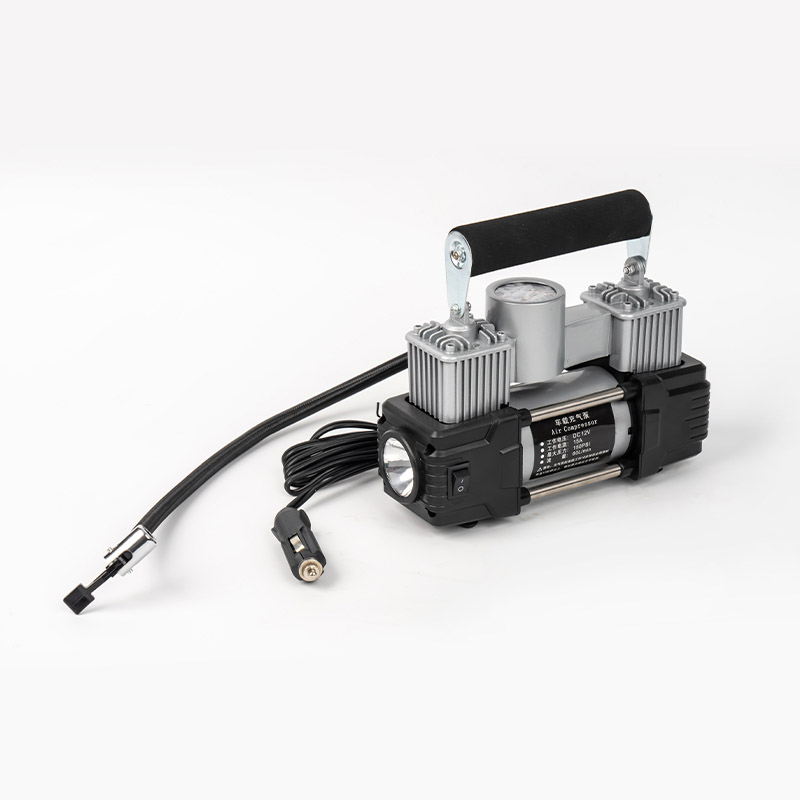
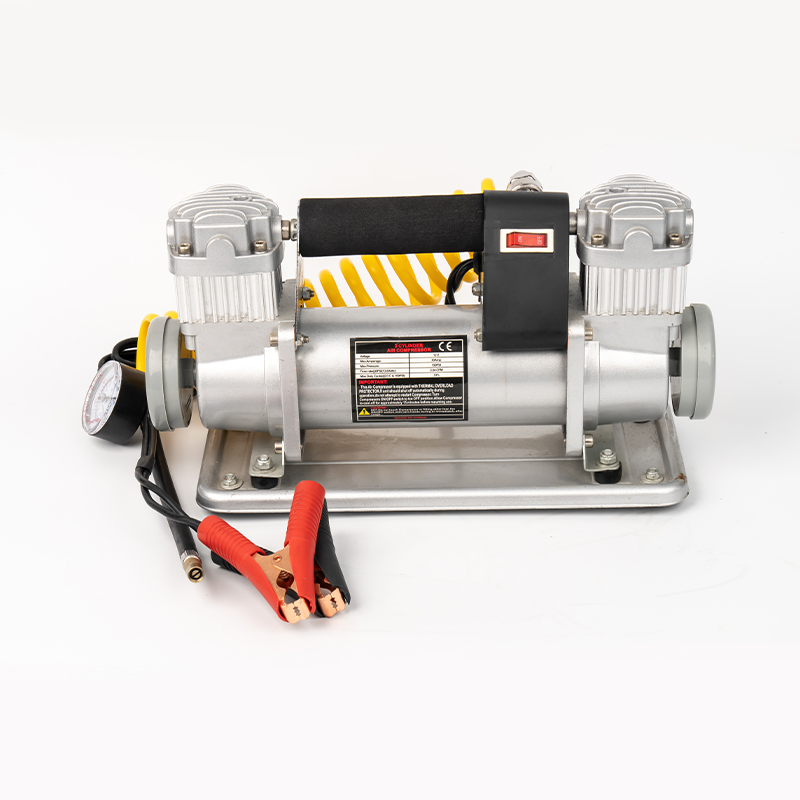
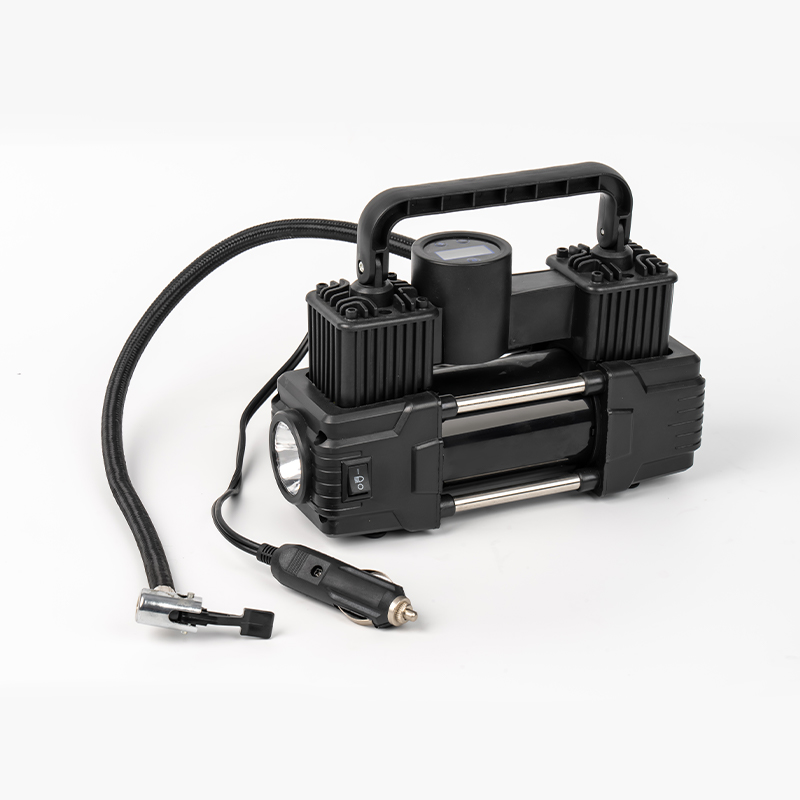
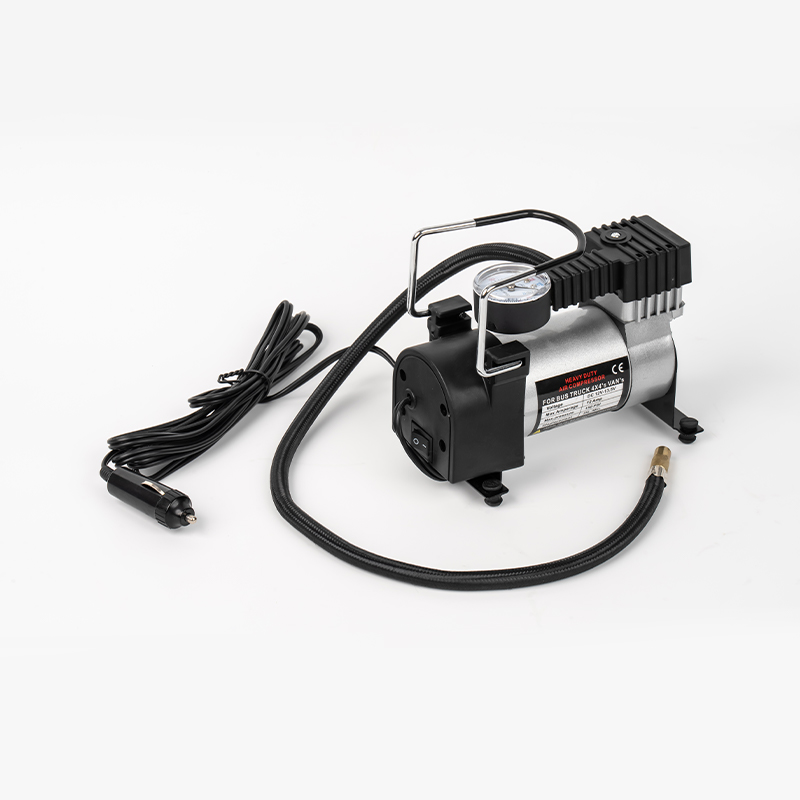
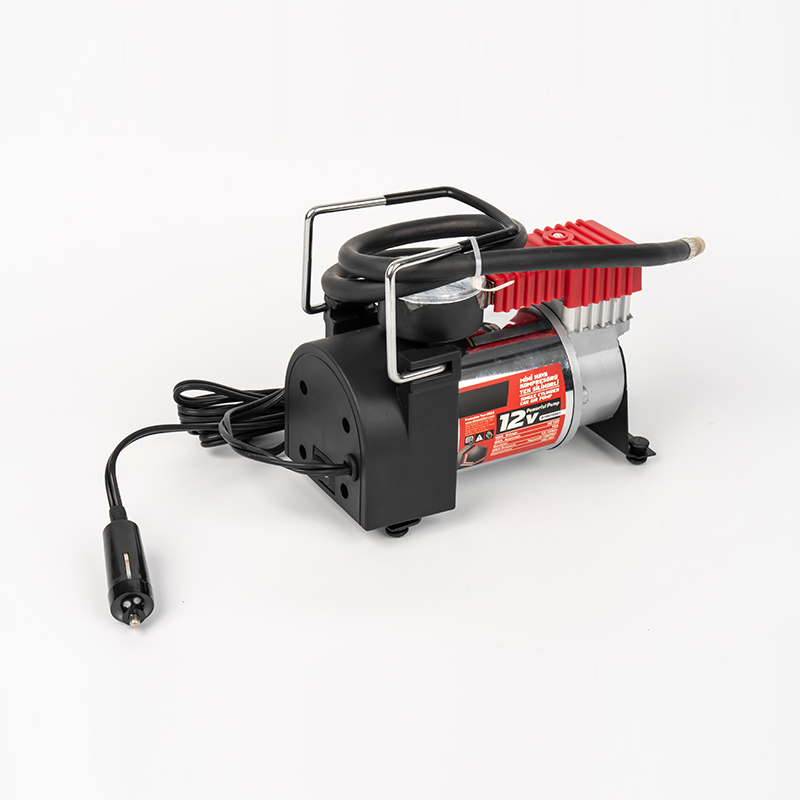
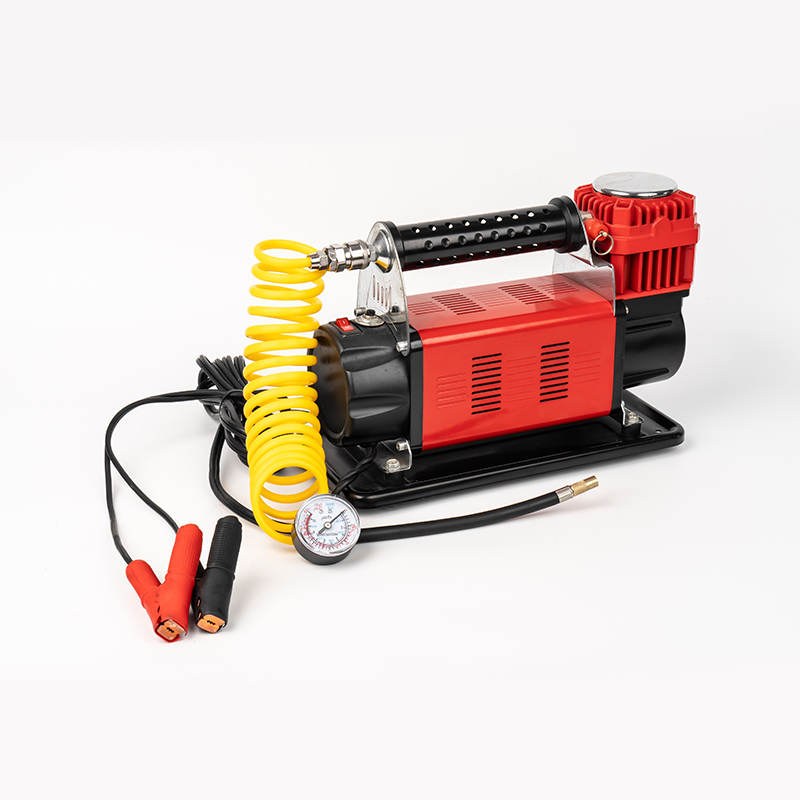
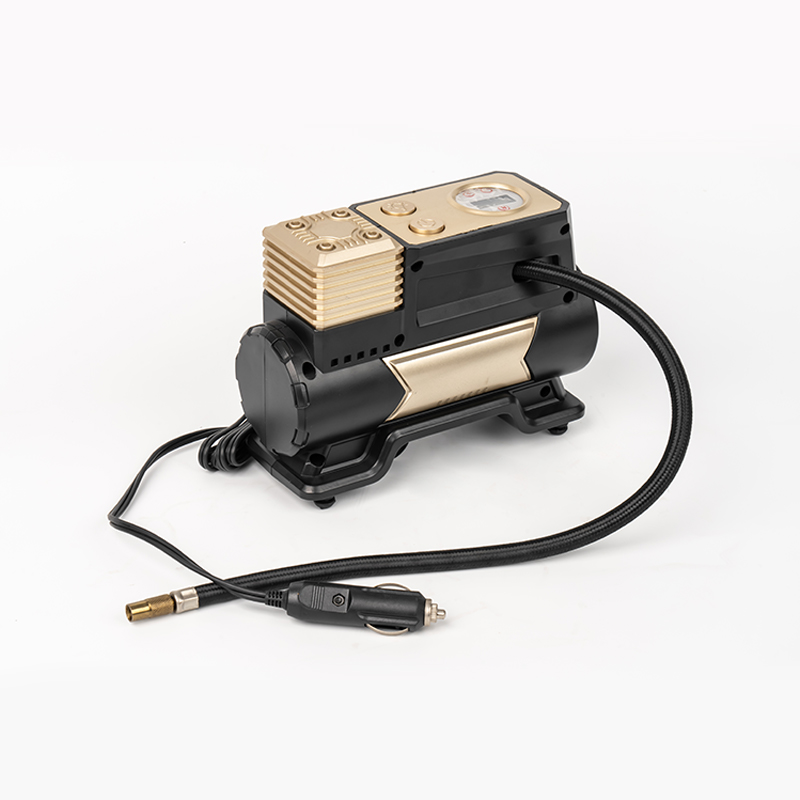
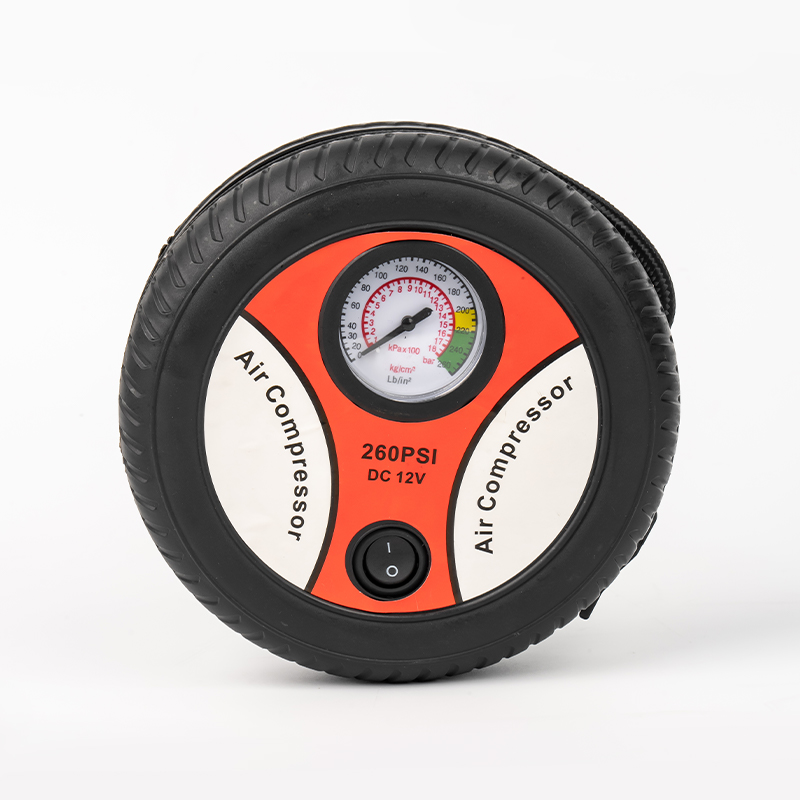
Designed for tire inflation and emergency roadside use only. A 12V portable compressor is limited to 25–40 PSI maximum (some reach 100 PSI but very slowly) and typically delivers less than 1 CFM — adequate for inflating a passenger tire from 20 to 35 PSI in 2–5 minutes, but completely insufficient for any pneumatic tool. Weight is usually 2–5 lb. Best kept in every vehicle as an emergency backup.
Battery-Powered (Cordless) Compressor
The fastest-growing segment in portable air compressor technology. Battery-powered compressors using 20V or 40V tool batteries can deliver 1.5–2.5 CFM at 90 PSI — sufficient for framing nailers, brad nailers, and tire inflation without any cord. A 4Ah battery typically provides 20–50 nail gun cycles before needing recharging. The trade-off is cost (battery packs add $60–$150 to the price) and the fact that battery CFM output is still below the best corded models. Ideal for rooftop work, remote sites, and anywhere cords are impractical.
| Power Source | Typical Max CFM | Max PSI | Best Use | Limitation |
|---|---|---|---|---|
| 120V AC | 2.5–6 CFM | 150–175 PSI | Workshop, garage, jobsite with power | Needs power outlet, cord length |
| 240V AC | 5–10 CFM | 175 PSI | Sustained heavy tool use | Requires 240V outlet, less portable |
| 12V DC | 0.3–0.8 CFM | 100 PSI | Tire inflation, roadside emergency | No tool use, very slow fill rate |
| Battery (20–40V) | 1.2–2.5 CFM | 135–150 PSI | Remote work, roofing, finish nailers | Battery life, higher initial cost |
Table 2: Portable air compressor power source comparison by CFM output, maximum PSI, typical use case, and key limitation. Choose the power source based on where and how the compressor will be used.
What Features and Build Quality Indicators Matter Most?
Beyond the core performance specs, several build quality and convenience features separate a durable, professional-grade portable air compressor from a budget unit that will fail under regular use. These are the details that buying guides often overlook but experienced users consistently cite as deciding factors.
Tank Material and Drain Valve
Steel tanks are standard and durable, but they rust internally if moisture is not drained regularly. Every portable air compressor tank accumulates condensate — especially in humid climates — and a tank full of water will corrode from the inside, weakening the vessel wall and eventually causing catastrophic failure. Check that the drain valve is easily accessible and preferably a ball valve (quarter-turn) rather than a petcock (slow, annoying to operate). Drain the tank after every use. A tank that is never drained will show internal rust within 6–12 months in humid conditions and may fail its pressure rating within 3–5 years.
Regulator and Gauges
A good portable compressor should have two gauges: one showing tank pressure and one showing regulated output pressure. The regulator knob should lock in position (push-to-adjust, then releases) so vibration does not change the set point during operation. Cheap regulators with plastic bodies and imprecise adjustments are a common failure point — after 6–18 months, they may not hold a stable output pressure, causing inconsistent tool performance. Metal-bodied regulators with a smooth, consistent adjustment range are worth the premium on any unit above $100.
Thermal Overload Protection
Thermal overload protection automatically shuts the motor off if it overheats — a critical safety feature on any compressor that may be run continuously for extended periods. Without it, an overtaxed motor will burn out. Look for a manual reset button (usually a small red or black button on the motor housing) that confirms the unit has thermal protection. Allow the compressor to cool for 20–30 minutes before resetting after a thermal shutdown event.
Air Filter and Intake Design
The intake air filter prevents dust and debris from entering the pump. On job sites with drywall dust, wood sawdust, or concrete particles, a clogged filter will reduce airflow and cause the motor to overwork. Choose a portable air compressor with a washable or replaceable filter element, and position the intake away from the ground or dusty surfaces when operating. Some professional models include a remote intake extension hose for this purpose.
Handle, Feet, and Balance
A well-designed handle is not a minor detail on a 30 lb compressor you will carry up a ladder. Look for a wide, comfortable grip with adequate clearance for gloved hands. Rubber feet prevent vibration from walking the unit across smooth floors and reduce transmitted noise by 3–5 dB. On pancake compressors, check that the feet are positioned to distribute load evenly on sloped surfaces — cheap units tip over on anything less than a flat floor.
What Noise Level Is Acceptable in a Portable Air Compressor?
A standard oil-free portable air compressor runs at 78–87 dB(A) — roughly as loud as a vacuum cleaner or a busy restaurant. This is acceptable outdoors and in open workshops, but genuinely disruptive in occupied buildings, apartments, or enclosed garages where echo amplifies the sound. Ear protection (rated at NRR 25 or higher) is recommended for anyone working within 3 meters of a running compressor above 80 dB.
If noise is a concern, the options are:
- Ultra-quiet oil-free compressors: Marketed as 60 dB or below. These use slower-speed motors (1,450–1,750 RPM vs. the standard 2,850–3,450 RPM) and larger pumps to move the same air volume more quietly. Typical weight is 35–55 lb. Price premium is 50–120% over equivalent-capacity standard models.
- Oil-lubricated compressors: Inherently quieter at 60–72 dB due to the cushioning effect of oil between pump components. A quality oil-lube compressor at 65 dB is usable in a residential garage without disturbing neighbors.
- Remote placement: Running the compressor in an adjacent room or outside with an extended air hose (up to 100 ft of 3/8-inch hose with minimal pressure loss at low CFM demand) reduces the noise at the work area by 10–15 dB.
FAQ: What to Look for in a Portable Air Compressor
Q: What size portable air compressor do I need for a nail gun?
For a finish nailer or brad nailer, a portable air compressor with a 2–4 gallon tank and at least 1.5 CFM at 90 PSI is sufficient — these tools fire in short bursts and the tank refills between shots. For a framing nailer operating at a high pace (3–4 shots per second), choose a 4–6 gallon tank compressor with at least 3.0 CFM at 90 PSI to avoid running the motor continuously. A 6-gallon pancake compressor delivering 3.5 CFM at 90 PSI handles the vast majority of nail gun applications a DIYer or trim contractor will encounter.
Q: Can I use a portable air compressor to run an impact wrench?
Yes, but the compressor must be adequately sized. A 1/2-inch impact wrench requires 4–5 CFM at 90 PSI. A standard 6-gallon pancake compressor at 2.6 CFM cannot keep up with this demand — the tool will start losing power as the tank pressure drops toward the cut-in pressure. You need a twin-stack or wheeled compressor delivering at least 5 CFM at 90 PSI for sustained impact wrench use. For occasional lug nut removal (10–15 seconds at a time with recovery time between), a 4–6 gallon unit at 3.5+ CFM may get by, but it will cycle frequently and the motor will run hot.
Q: How long does a portable air compressor last?
A quality oil-free portable air compressor used for occasional DIY work should last 10–15 years with proper maintenance (draining the tank, keeping the filter clean). Under heavy daily professional use, oil-free pump life is typically 500–2,000 hours — equivalent to 1–4 years of full-time contractor work. Oil-lubricated compressors, maintained with regular oil changes every 3 months or 200 hours, routinely last 3,000–5,000 pump hours under equivalent load — roughly 2–3 times longer than oil-free equivalents.
Q: Is a higher HP motor always better in a portable air compressor?
Not necessarily — and buyers should be cautious about inflated horsepower claims. Many budget compressors advertise "peak HP" (the very brief spike at motor startup) rather than "running HP" (the sustained output). A unit claiming "3.0 HP peak" may actually deliver only 1.5–1.8 HP running, which is the number that determines actual CFM output. When comparing compressors, use CFM at 90 PSI as your benchmark, not the advertised HP. A well-designed 1.5 HP motor with an efficient pump can outperform a cheaply made 2.0 HP unit in real-world CFM delivery.
Q: What is a good PSI for a portable air compressor for tires?
Any portable air compressor with a maximum PSI of 100 or above can inflate passenger car tires (typically 30–50 PSI) and light truck tires (typically 35–80 PSI). For RV tires, medium truck tires, or sport tires requiring 80–100 PSI, ensure the compressor's regulated output can reach at least 100 PSI. For off-road or commercial truck tires requiring 100–150 PSI, you need a compressor rated to at least 150 PSI maximum with an output regulator capable of the same. The speed of inflation matters too — a 12V unit may take 8–15 minutes to fill a flat passenger tire, while a 120V pancake compressor handles the same task in 2–3 minutes.
Q: How much should I spend on a portable air compressor?
Budget determines what quality tier you can access. A $60–$100 unit will handle light inflation and occasional brad nailing for DIY use, but expect a shorter service life and louder operation. The $150–$250 range covers the best-selling 6-gallon pancake compressors that professional contractors rely on daily for nailer work. The $300–$500 range gets you into twin-stack and larger wheeled models with genuine 5–6 CFM output, suitable for impact tools and light spray work. Above $500 you enter the quiet, oil-lubricated, and high-CFM territory appropriate for painting, daily sustained tool use, or quiet indoor work. For most homeowners and occasional contractors, the $150–$250 range delivers the best value — professional-grade build quality at an accessible price point.
Final Checklist: What to Look for in a Portable Air Compressor
Use this checklist to evaluate any portable air compressor before you buy. Check every item against your actual intended use, not the theoretical maximum the compressor might be used for someday.
- CFM at 90 PSI meets or exceeds your most demanding tool requirement plus a 25% buffer.
- Tank size matches your use pattern — small for intermittent nailer work, larger for sustained tool use.
- Maximum PSI is at least 125 for general use; 150+ for tools requiring higher regulated pressure.
- Power source matches your work environment — 120V AC for most workshops, battery for remote sites, 12V only for tire inflation.
- Oil-free or oil-lubricated selected based on maintenance willingness, noise requirements, and duty cycle.
- Noise level is acceptable for the environment — below 75 dB for indoor residential use.
- Drain valve is easily accessible and preferably a quarter-turn ball valve.
- Thermal overload protection is present — confirmed by a reset button on the motor housing.
- Weight and handle suit the portability demands of your work — if you carry it daily, every pound matters.
- Warranty is at minimum 1 year on parts and labor; 2–3 years on pump is a sign of manufacturer confidence.
The right portable air compressor is not the most powerful or the most feature-rich — it is the one that reliably delivers the air your tools need, in the places you work, without demanding more maintenance attention than your schedule allows. Match the spec to the job, and the compressor will repay the investment many times over in reliable, consistent performance.